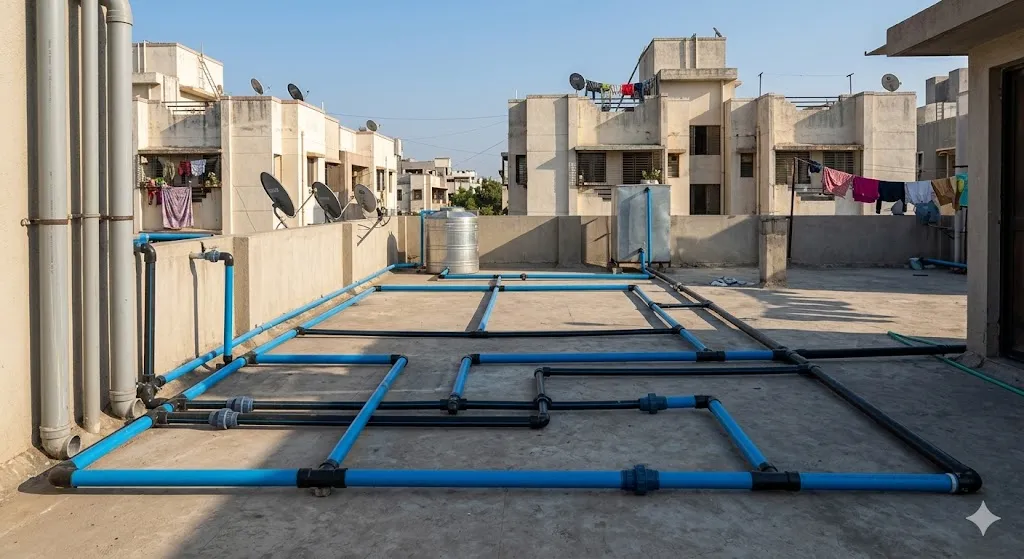
Connecting a rainwater harvesting system to building plumbing involves more than connecting a storage tank to a water pipe. The system needs to collect, filter, store and distribute harvested water while accounting for pressure, overflow, maintenance and any required backup supply. This becomes especially important when rainwater is intended for toilets or other non-potable applications. For wider building requirements, see our plumbing services in India.
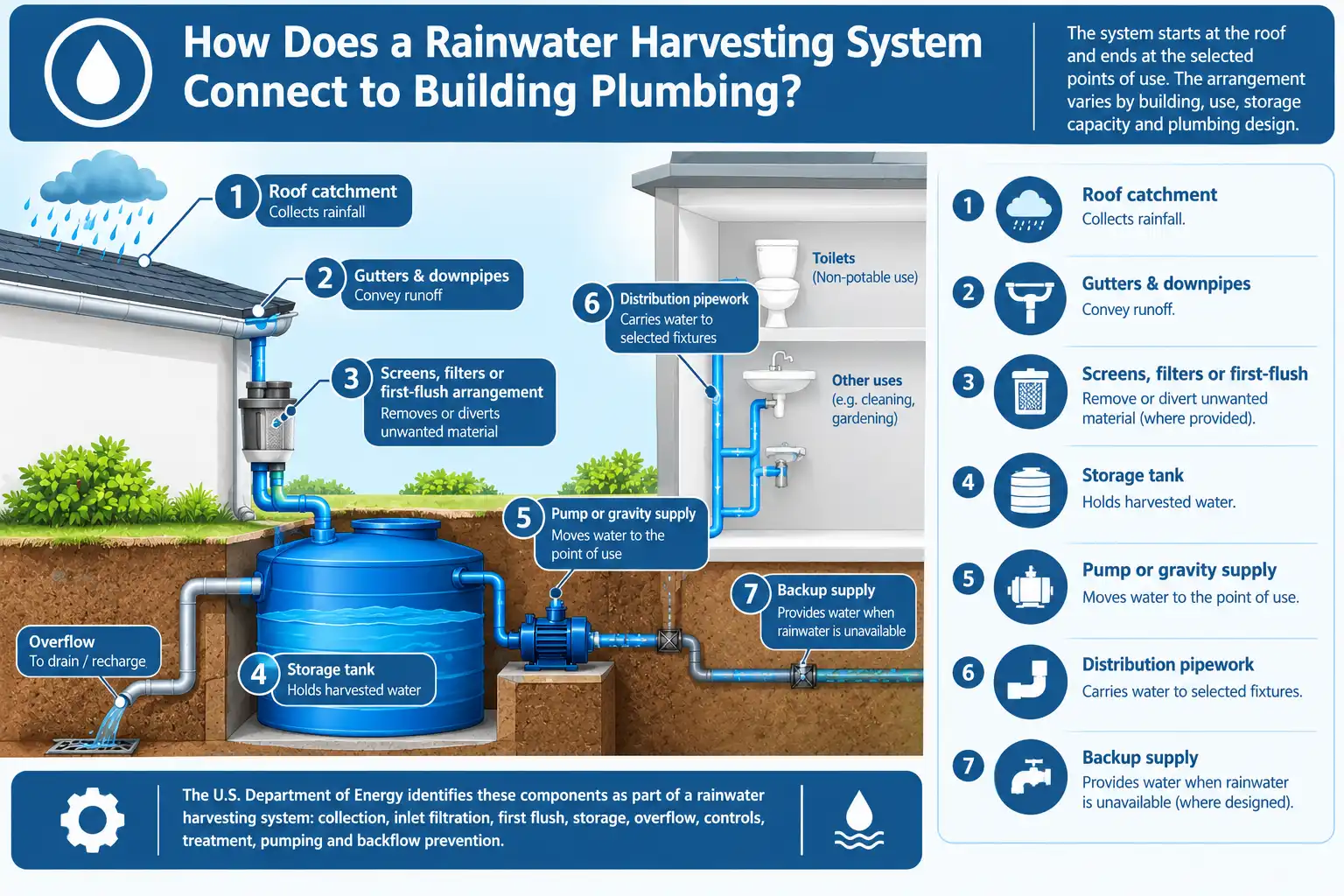
How Does a Rainwater Harvesting System Connect to Building Plumbing?
A building rainwater harvesting system generally starts at the roof and ends at the selected points of use. The exact arrangement varies according to the building, intended use, storage capacity and plumbing design.
A typical arrangement follows this sequence:
- Roof catchment collects rainfall.
- Gutters and downpipes convey the runoff.
- Screens, filters or first-flush arrangements remove or divert unwanted material where provided.
- Storage tank holds the harvested water.
- Pump or gravity supply moves water towards the point of use.
- Distribution pipework carries the water to selected fixtures.
- Backup supply can provide water when stored rainwater is unavailable, where the system is designed for it.
1. Collect Rainwater From the Roof
The roof provides the catchment area for the system. Rainwater flows from the roof into gutters and downpipes, which direct it towards the harvesting system. The collection area should be kept reasonably clean because leaves, dirt and other debris can enter the system with runoff.
2. Filter and Direct the Collected Water
A screen or filter can help prevent larger debris from entering the storage system. A first-flush arrangement may also be used to divert an initial portion of roof runoff before water enters the storage tank. CPHEEO maintenance guidance specifically recommends cleaning gutters before the monsoon and using a first-flush arrangement to divert initial rainfall.
3. Store the Harvested Water
The filtered water is directed to a storage tank. The tank should be designed with suitable access, cleaning arrangements and overflow provisions for the particular installation.
4. Distribute Water to the Required Fixtures
From the tank, water can be supplied to the intended non-potable applications. Where gravity does not provide adequate pressure, a pump can be incorporated into the distribution system.
Can Rainwater Harvesting Be Connected to Toilet Plumbing?
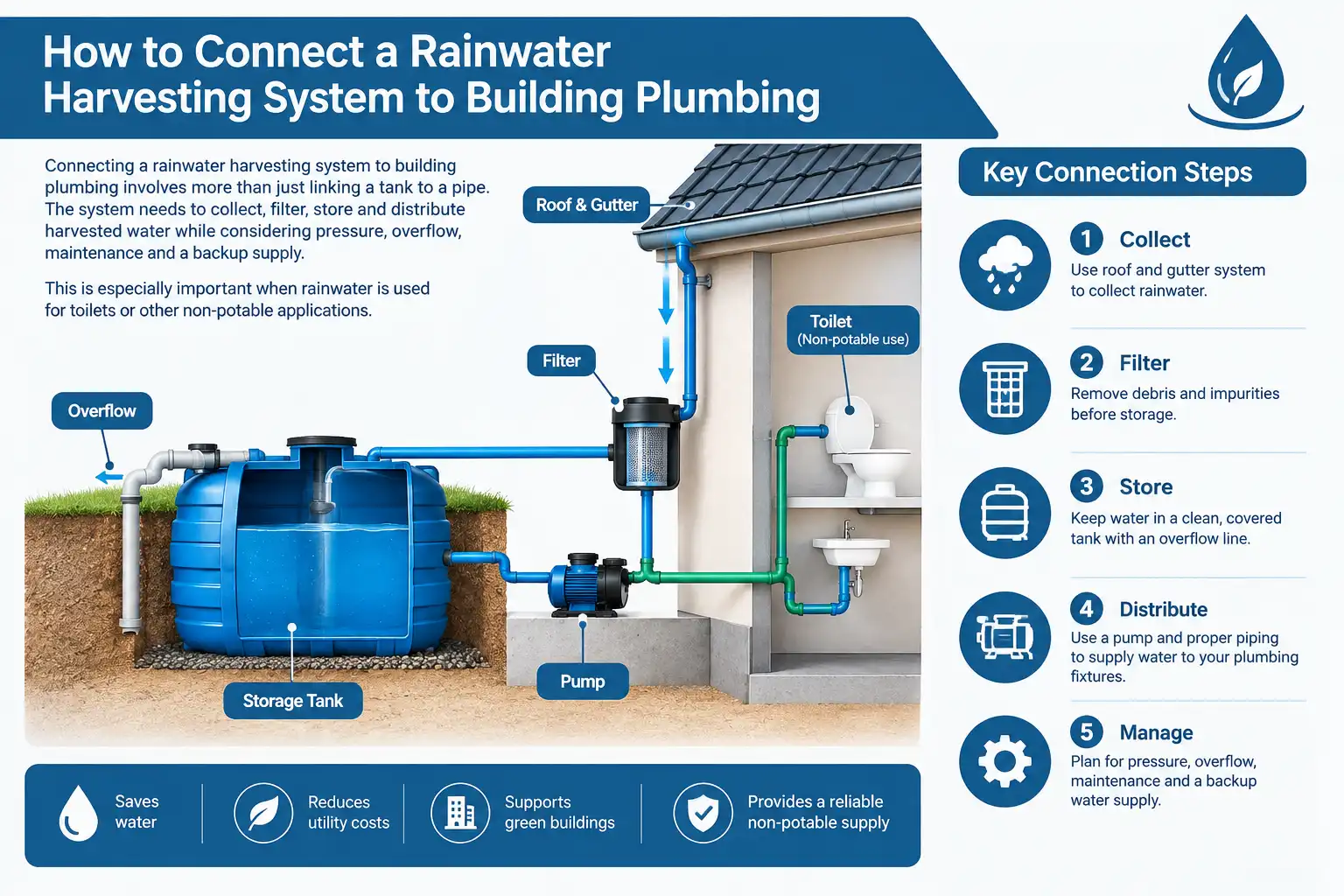
Yes, appropriately designed rainwater systems can supply toilet flushing as a non-potable application. The important consideration is that the rainwater supply should be treated and distributed according to its intended use and applicable requirements.
Common non-potable applications for harvested rainwater include:
- Toilet flushing
- Urinal flushing
- Landscape irrigation
- Gardening
- Vehicle washing
- Other designated non-potable applications
When rainwater is used for toilet flushing, the plumbing arrangement needs to distinguish the non-potable supply from potable water. A dual-piping arrangement is one approach described in technical guidance, with separate lines for harvested rainwater and potable water. The final arrangement should be determined according to the building design and applicable local requirements.
How Does Rainwater Reach Toilets From the Storage Tank?
Gravity-Fed Supply
If the tank is positioned sufficiently above the point of use, gravity can provide the driving pressure. Whether this is practical depends on the tank elevation, pipework and pressure required at the fixture.
Pumped Supply
A pump can be used where gravity does not provide sufficient pressure. The pump should be considered together with the expected flow, pipe routing, elevation and number of fixtures being supplied.
What Happens When the Rainwater Tank Runs Empty?
This is one of the practical problems that can appear after connecting rainwater harvesting to building plumbing. The key design question is: what supplies the fixture when harvested rainwater is unavailable?
A system intended to provide reliable service may therefore need an appropriate alternative water supply or another method of managing low-water conditions. Depending on the design, the system may use:
- Mains-water backup
- Controlled tank top-up
- Automatic changeover
- Manual bypass
- Low-level pump protection
- Another approved water source
These arrangements are not interchangeable. The appropriate solution depends on the system design and applicable requirements.
How Does Mains Water Backup Work With Rainwater Harvesting?
Mains water can be incorporated as a backup source when harvested rainwater is unavailable, but the connection needs to be designed carefully. The objective is to maintain the required service without creating an inappropriate connection between potable and non-potable water.
Automatic Mains Water Changeover
An automatic arrangement can be designed so that the alternative water supply becomes available when the rainwater system cannot meet the demand. The actual control method depends on the installation.
Controlled Tank Top-Up
Another approach is to maintain a minimum water level through a controlled backup supply. This can help avoid situations where the storage tank becomes completely empty, although the connection must still be designed to protect the potable supply where applicable.
Manual Bypass
Some systems may incorporate a manual bypass for maintenance or operational purposes. A manual arrangement requires clear identification of the relevant valves and a suitable operating procedure.
Why Is Backflow Prevention Important?
Rainwater used for non-potable purposes should not be treated as though it were automatically interchangeable with potable water. When rainwater and mains water are brought into the same building plumbing arrangement, the possibility of unwanted reverse flow needs to be considered.
What Is Backflow?
Backflow is unwanted movement of water in the reverse direction within a connected plumbing system. The concern becomes particularly important when the two water sources have different intended uses or water-quality characteristics.
How Is Cross-Connection Avoided?
The specific arrangement depends on the project and applicable plumbing requirements. Depending on the system, considerations can include:
- Separate water distribution lines
- Appropriate backflow protection
- Suitable separation between water sources
- Correct valve arrangements
- Clear identification of non-potable pipework
- Proper maintenance access
How Do You Maintain Water Pressure in a Rainwater Plumbing System?
Having water stored in a tank does not automatically mean that the fixtures will receive adequate pressure. Pressure depends on factors such as tank elevation, pipe routing, pump selection and the demand placed on the system.
Common factors that affect rainwater pressure include:
- Tank elevation
- Distance between tank and fixture
- Pipe diameter
- Number of fittings
- Vertical rise
- Number of simultaneous users
- Pump capacity
- Condition of filters and pipework
A pump may be required when gravity cannot provide the required pressure at the point of use. The pump should be selected according to the hydraulic requirements of the system rather than simply according to the size of the storage tank.
What Components Are Used to Connect Rainwater Harvesting to Plumbing?
| Component | Purpose |
|---|---|
| Roof catchment | Collects rainfall |
| Gutters and downpipes | Convey roof runoff |
| Screen / filter | Helps remove debris |
| First-flush arrangement | Diverts initial runoff where included |
| Storage tank | Stores harvested water |
| Pump | Moves water where gravity is insufficient |
| Distribution pipework | Carries water to selected fixtures |
| Control valves | Control or isolate sections |
| Backup supply | Provides an alternative source where designed |
| Backflow protection | Helps prevent unwanted reverse flow |
| Overflow | Safely manages excess stored water |
| Water-level control | Monitors or manages tank level where required |
Not every project needs every component. The final selection should follow the intended application and system design.
How Should Rainwater Harvesting Plumbing Be Planned for a Building?
The most reliable approach is to plan the rainwater system alongside the building's wider plumbing infrastructure. This is particularly important when the system will serve multiple fixtures or connect with an existing water supply.
1. Define Where the Water Will Be Used
Start by identifying the intended applications such as toilet flushing, irrigation, gardening, cleaning or other approved non-potable uses. The intended use influences the treatment, distribution and control requirements.
2. Assess the Roof and Collection Arrangement
The available roof area affects how much rainfall can potentially be collected. Gutters, downpipes, filters and first-flush arrangements should be considered as part of the collection system.
3. Determine Storage Requirements
The tank should be selected according to the project's water demand, rainfall characteristics, available space and intended operating pattern. Simply installing the largest possible tank does not automatically produce the best system.
4. Plan the Distribution Network
The route from the tank to the fixtures should be established before installation. Consider pipe routing, elevation, fixture locations, pump position, maintenance access and isolation points.
5. Decide How Backup Water Will Work
If the building requires continued service during dry periods, determine how the alternative supply will operate. This should be planned before the rainwater pipework is connected to the building's existing plumbing.
6. Consider Backflow and Cross-Connection Protection
The rainwater system and potable supply should be assessed together wherever they interact. The required protection should follow the applicable plumbing requirements for the project.
What Are the Common Problems With Rainwater Harvesting Plumbing?
1. Toilets Stop Receiving Water
Possible causes can involve the tank level, pump, controls, valves, filtration or distribution pipework. The actual cause needs to be established from the installed system rather than assumed from one symptom.
2. Mains Water Does Not Take Over
If backup water has been incorporated, the problem may involve the particular control, valve or changeover arrangement. This can be difficult to diagnose without understanding the complete pipe arrangement.
3. Water Pressure Is Too Low
A tank can contain water while the fixtures still receive insufficient pressure. The tank elevation, pump, pipework and fixture demand should be assessed together.
4. Pump Runs With Low Water Level
If the tank level falls too far, the pump may not have suitable operating conditions. Low-level controls and appropriate pump protection can help address this depending on the system.
5. Filters Become Blocked
Debris from the roof can accumulate in filters and affect water flow. CPHEEO maintenance guidance recommends keeping the roof, gutters, filtration unit and storage tank clean and maintaining the first-flush arrangement.
6. Overflow Is Not Properly Managed
A full storage tank needs a suitable overflow arrangement. Rainwater system guidance identifies overflow as a specific component to be considered in storage tank design.
7. Rainwater and Potable Water Are Incorrectly Connected
An inappropriate connection between water sources can create a cross-connection and backflow concern. This is why the relationship between the rainwater and potable-water systems needs to be considered during design.
How Should a Rainwater Harvesting System Be Maintained?
A rainwater harvesting system continues to depend on the condition of its collection, filtration and storage components after installation. Basic maintenance areas include:
- Roof: Keep the catchment area reasonably clean.
- Gutters: Remove accumulated leaves and debris.
- Filters: Inspect and clean according to the system requirements.
- First flush: Ensure the arrangement remains functional.
- Storage tank: Inspect and clean as required.
- Pump: Check operating condition and controls.
- Pipework: Inspect for leakage or restrictions.
- Overflow: Keep the discharge route clear.
- Valves: Check accessible isolation and control components.
- Backup system: Periodically verify that the intended backup arrangement operates correctly.
Maintenance requirements should follow the actual equipment and project specifications.
Rainwater Harvesting and Plumbing Services by VM Engineers
Rainwater harvesting works best when its collection, storage and distribution arrangements are considered alongside the building's wider plumbing system. For projects involving water supply, drainage, concealed plumbing lines, rainwater harvesting and related building plumbing requirements, explore our plumbing services in India.
VM Engineers can assess the plumbing requirements of the project based on the building layout, intended water use and existing infrastructure.